Peer Reviewed Articles Negative Images in the Media for Women and Body Image
The complicated truth about social media and trunk epitome
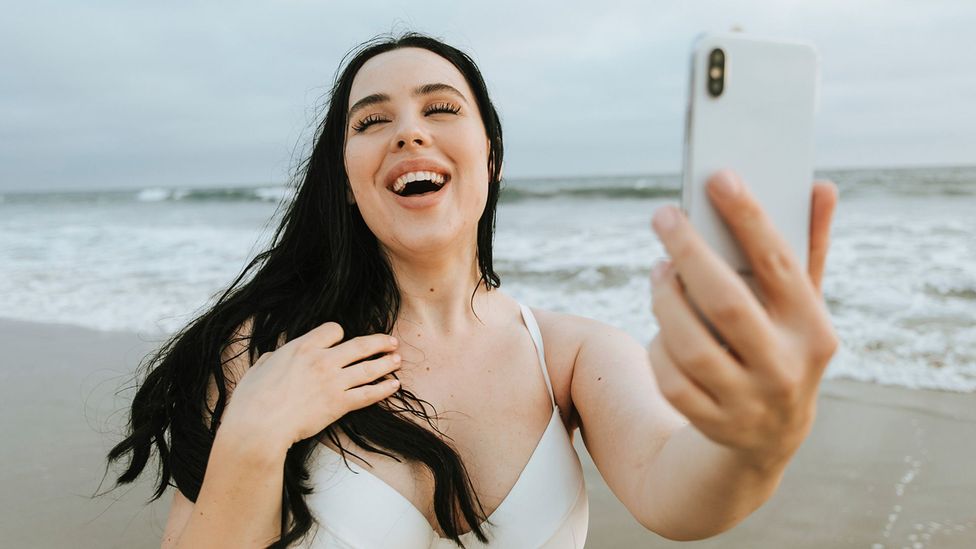
Many of u.s. suspect that the beautiful, ofttimes highly-edited images of people we meet on social media brand us feel worse about our own bodies. But what does the inquiry say?
I
If y'all mindlessly scroll through Instagram or Facebook whenever yous get a few seconds of reanimation, you lot're far from alone. But have you ever wondered how all those images of other people's bodies – whether your friend's holiday snap or a celebrity'south gym selfie – could be affecting how yous view your ain?
Much has been fabricated over the years about how mainstream media presents unrealistic dazzler standards in the class of photoshopped celebrities or stick-thin fashion models. Now that influencers fill up upward our feeds, it's easy to imagine that social media, too, is all bad when it comes to trunk image.
Just the reality is more nuanced, and there may be ways to curate your Instagram feed to make y'all feel happier in your own peel – or, at least, end you feeling worse.
You might as well like:
● Is social media bad for you lot? The knowns and unknowns
● Why information technology pays to declutter your digital life
● How much is 'too much time' on social media?
It's important to notation that research into social media and torso epitome is still in its early stages, and nigh studies are correlational. This means we tin can't prove whether, for example, Facebook causes someone to accept negative feelings almost their appearance, or whether people who are concerned nigh their appearance are more likely to use Facebook.
That being said, using social media does announced to be correlated with body epitome concerns. A systematic review of 20 papers published in 2016 found that photo-based activities, similar scrolling through Instagram or posting pictures of yourself, were a particular problem when information technology came to negative thoughts nigh your trunk.

Photograph-based activities online, like scrolling through Instagram, have been correlated with feeling more negatively almost your trunk (Credit: Getty)
But there are many different means to use social media – are yous but consuming what others post, or are you taking, editing and uploading selfies? Are you following close friends and family, or a laundry list of celebrities and influencers?
Research suggests that who we compare ourselves to is key.
"People are comparing their appearance to people in Instagram images, or whatsoever platform they're on, and they often judge themselves to be worse off," says Jasmine Fardouly, a postdoctoral researcher at Macquarie Academy in Sydney, Australia.
In a survey of 227 female university students, women reported that they tend to compare their own appearance negatively with their peer group and with celebrities, but not with family members, while browsing Facebook. The comparison grouping that had the strongest link to torso image concerns was distant peers, or acquaintances.

Looking at celebrities made women feel worse about their bodies – merely images of acquaintances came with an even stronger link to body image concerns (Credit: Getty)
Fardouly puts this down to the fact that people present a one-sided version of their life online. If you know someone well, you'll know they're simply showing the best bits – but if they're an acquaintance, you lot won't have whatsoever other information to get on.
Negative influence
When it comes to the wider circle of influencers and accounts you follow, not all types of content are equal.
Research suggests that "fitspiration" images in particular – which typically feature beautiful people doing practice, or at to the lowest degree pretending to – might brand you harsher on yourself.
Amy Slater, an acquaintance professor at the University of W England, Bristol, published a written report in 2017 in which 160 female undergraduates viewed either #fitspo, cocky pity quotes, or a mix of both, all sourced from existent accounts on Instagram. Those who viewed just #fitspo scored lower on self-pity, merely those who viewed the compassionate quotes (e.g. "You lot're perfect just the fashion you are") were nicer to themselves – and felt amend about their bodies.
For those who viewed both the #fitspo and the self-compassion quotes, the benefits of the latter appeared to outweigh the negatives of the onetime.
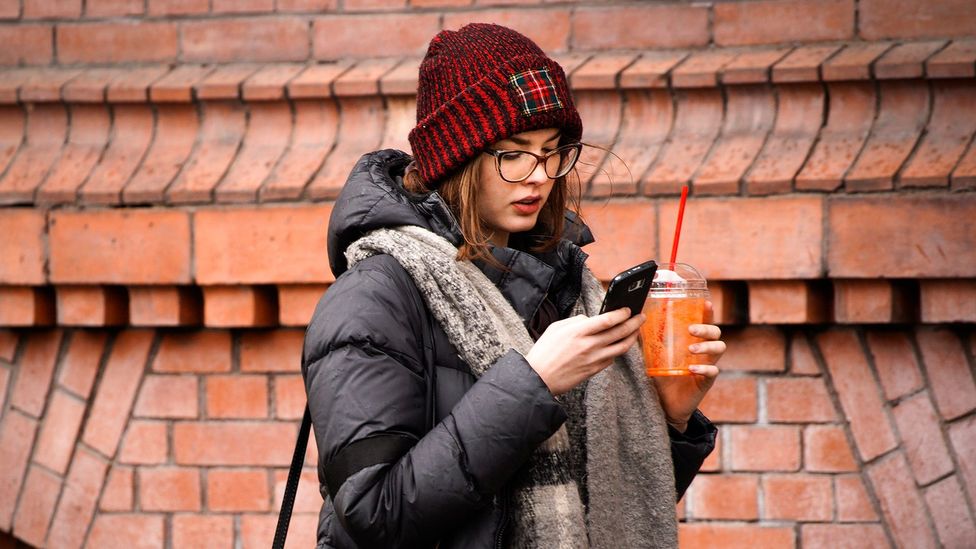
Looking at self-compassion quotes on social media made people feel better virtually themselves (Credit: Getty)
Another written report published earlier this year involved showing 195 young women either body-positive content from popular accounts like @bodyposipanda, photos showing thin women in bikinis or fitness gear, or neutral images of nature. The researchers found that exposing women to #bodypositive Instagram content appeared to heave their satisfaction with their ain bodies.
"Those two things together are starting to build a little chip of a story that in that location may be some content that really is useful for trunk image," says Slater.
Only at that place may exist a downside to torso-positive images, too: they're still focusing on bodies. The same study plant that women who'd seen the body-positive photos however concluded up objectifying themselves – measured when, after looking at the images, the participants were asked to write 10 statements about themselves. The more the statements focussed on their appearance rather than their skills or personality, the college that participant scored on self-objectification.
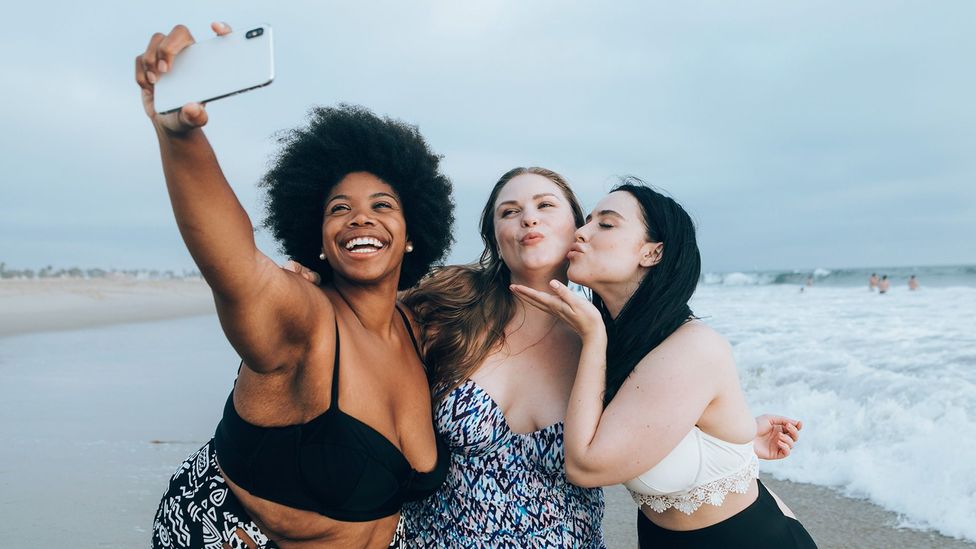
When study participants viewed body-positive content, they felt ameliorate nigh their own bodies – but in that location was a take hold of (Credit: Getty)
That means when someone wrote "I am beautiful" it got lumped in with negative things people said nigh their bodies. Just those people could be taking a broader view of where their dazzler comes from, including internal likewise every bit physical attributes, says Slater.
Either manner, this fixation with looks is a criticism of the trunk-positive motility that does seem to concord truthful. "It is well-nigh loving the body, just it is nonetheless very much about a focus on advent," says Fardouly.
Self(ie) love
When it comes to posting our own pictures on social media, selfies tend to exist the focus.
For a study published last yr, Jennifer Mills, an associate professor at York University, Toronto, asked female person undergraduates to take a selfie on an iPad and upload information technology to either Facebook or Instagram. I grouping could just take a unmarried motion picture and upload it without editing, but the other had a chance to have as many as they wanted and retouch their selfie using an app.
Mills and her colleagues found that all the selfie takers felt less attractive and less confident later on posting than when they'd walked into the experiment – fifty-fifty those who'd been allowed to edit their photos to their heart'south content. "Even though they can brand the terminate result look 'better', they still are focused on aspects of what they don't like about the mode they look," she says.

In one experiment, women felt worse nearly themselves after posting a selfie online – even if they'd retouched information technology (Credit: Getty)
Some of the participants wanted to know if anyone had liked their photo before deciding how they felt about having posted it, although looking at interactions wasn't part of the study.
"In that location'south this rollercoaster of feeling broken-hearted then getting reassurance from other people that y'all await skilful," says Mills. "Just that probably doesn't last forever, and and so you take some other selfie."
In previous work published in 2017, researchers plant that spending a lot of fourth dimension perfecting selfies could be a sign that someone is struggling with body dissatisfaction.
Withal, some big holes remain in the enquiry on social media and body image.
Virtually of the work then far has focused on young women, as traditionally they have been the age group almost affected by body image concerns. But research including men is starting to show they're not allowed. For case, a study found that men who reported looking at male #fitspo content more frequently said they compared their own appearance to others more oft and cared about having muscles more than.
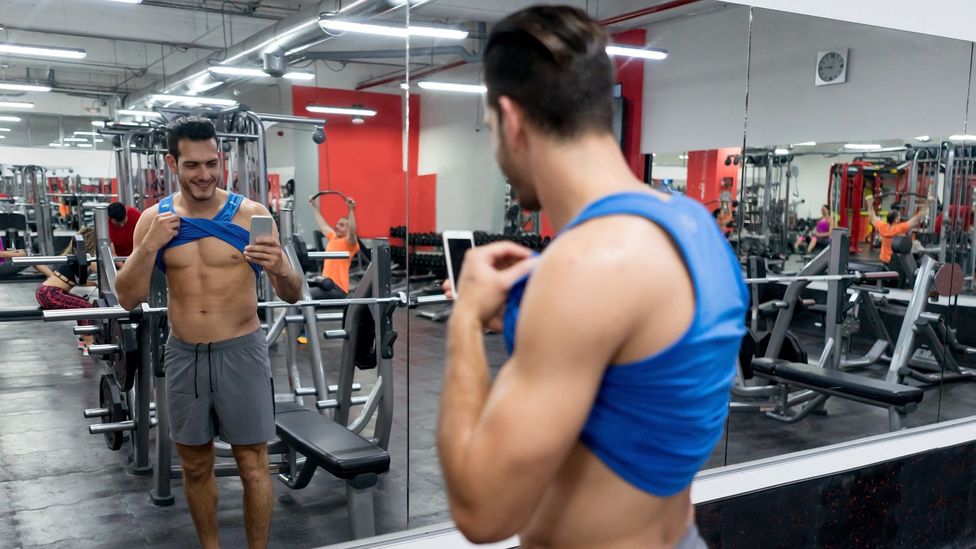
Men who look at #fitspo content more ofttimes cared more than about their own muscles (Credit: Getty)
Longer term enquiry is too an important next step, because lab experiments tin only provide a snapshot of any possible effects. "We don't really know whether over time [social media] has a cumulative effect on people or not," says Fardouly.
So, for now, how should you curate your ain social media feeds if you lot don't want to come away feeling bad about your body?
Mills has one takeaway that should work for everyone: put downward your phone.
"Take a break and engage in other activities that accept nix to exercise with appearance and comparison yourself to other people," she says.

The best advice? Put downwards your phone (Credit: Getty)
The next best thing would exist to think critically about who you follow – and, if you find yourself facing an endless stream of advent-focussed photos next fourth dimension y'all scroll, add some nature or travel into the mix.
Afterward all, giving upwardly social media altogether is probably too large of an ask for most people – especially while the long term effects of using it are yet unclear. But finding inspiring landscapes, succulent food, and beautiful dogs to fill your Instagram feed might simply help y'all remember there's more to life than what you await like.
Join 900,000+ Future fans by liking u.s. onFacebook, or follow us onTwitter or Instagram.
If you liked this story,sign up for the weekly bbc.com features newsletter, called "If Y'all But Read 6 Things This Week". A handpicked selection of stories from BBC Future, Civilisation, Uppercase, and Travel, delivered to your inbox every Fri.
Source: https://www.bbc.com/future/article/20190311-how-social-media-affects-body-image
0 Response to "Peer Reviewed Articles Negative Images in the Media for Women and Body Image"
Post a Comment